Showing posts with label Jamie Morris. Show all posts

Wednesday, November 16, 2011

Plotting the Second Half, Pt. 3

If you've been following this blog you've probably realized that I have slowed waaaay down on my posts, and I have NaNoWriMo to blame for it. I whizzed along for the first ten days thinking I could toss off this little 50,000-word exercise without breaking a sweat. When I hit mid-point in the novel those 1667 words per day began to come a lot harder.

Third Act Doldrums
So I called up a lady who knows a thing or two about plotting. Jamie Morris runs the Woodstream Writers Group in north Florida. I put the question to her: In a four-act structure, what the hell is supposed to happen in Act 3? Your character has bottomed out. She has to make it from that deep hole to the climax. Additionally, we're supposed to be right in the middle of "fun and games" as Blake Snyder puts it in his excellent book on plotting screenplays, Save the Cat. Where's my fun? Where's my games?

Here's what Jamie had to say:

Thursday, November 10, 2011

Plotting the Second Half, Pt 2: The Mavens Weigh In

Yup, bad sh*t happens in Act 3
Yesterday we talked a little about issues with plotting your novel's second half. I'm using a four-act structure rather than a three-act, and I'm a little concerned with how I'm going to keep the tension in my WIP from flat-lining after the midway point. So I got in touch with two of my fiction mentors, Jamie Morris and Joyce Sweeney, who invented the Plot Clock I'm using. Today I'll give you Joyce's take on this brain-teaser (look for Jamie's words of wisdom tomorrow).


Sweeney, being all
smart and stuff
Joyce says that the low point in the story comes at the end of Act 2 in both the four- and three-act models. After your character hits that low point, "it doesn't mean all the tension is over, you keep raising the stakes all the time," she says.

Monday, September 26, 2011

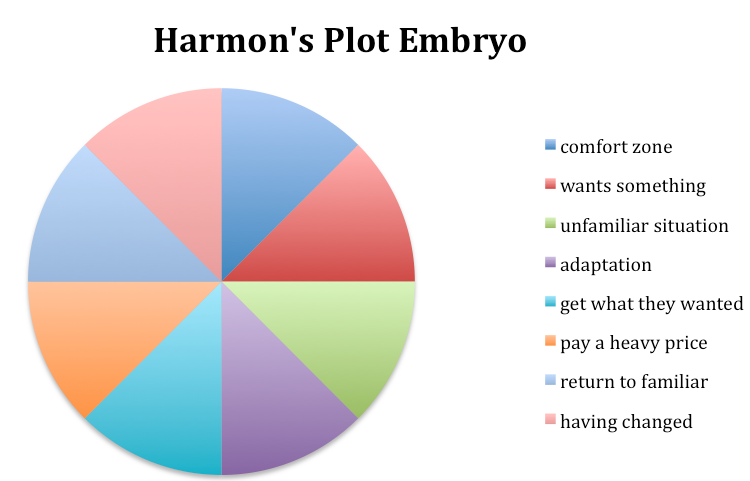
Dan Harmon's Plot Embryo

I've been obsessing about story structure lately. So I was glad to find, in this month's Wired magazine, a piece about Dan Harmon, the 38-year-old creator of the cult-sitcom Community. Harmon has invented plot circles, which he calls "embryos;" they share some similarities to the plot clocks Joyce Sweeney and Jamie Morris have come up with. I actually prefer the Sweeney/Morris version, but I think Harmon's vision is a useful one too. Harmon says this story structure is so "tattooed on his brain" that he can't not see it when he watches a movie, hears a song, or reads a book. Here's the breakdown on how it works:

Tuesday, September 20, 2011

Do You Connect With Your Concept?


Rockin' Around the Plot Clock
I just spent an amazing weekend with a dozen other writers, holed up in a house in Mount Dora, Florida. We dedicated 48+ hours of workshop time to thinking about plot.

I did a pretty good job plotting my first novel by the seat of my pants (I went back in revision and created a detailed step sheet), but I never really felt like I "got" plot. No matter how many craft books I read on the subject, how to structure a novel for maximum impact (and I mean, I wanted it to kill) just wasn't gelling for me.

After this weekend, consider me gelled. I get how the plot points fit together now, and how they ought to resonate off each other. I merely had to spend some time with Joyce Sweeney and Jamie Morris's brilliantly simple Plot Clock. The Plot Clock features in most of the Sweeney/Morris Next Level Weekend Craft Intensives, and I can't recommend these workshops too highly).

Tuesday, September 13, 2011

Writing the Second Novel: Three Things to Consider

I "started" novel number two this month, although I'm realizing that the verb "to start" is a slippery one. But I'm finding it useful to change up my process this time.

Here's what I'm doing differently:

1) I've got myself a new Scrivener program, which is going to make my research organize itself. Well, I hope so, anyway. Because novel number two is historical (Vietnam War), I'm going to have copious notes to keep track of. So far, I love Scrivener, which has all kinds of nifty gadgets for organizing characters, scenes, and locations, and umpteen methods of outlining. Anybody else out there in blog-land using it?